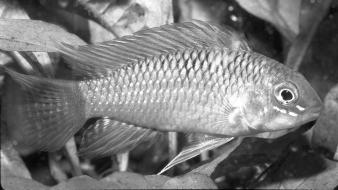
Male Apistogramma steindachneri in breeding dress The
pectoral fins are bright yellow and his body is sky blue.
Once upon a time Apisto’s weren’t easy to find in local shops. I
would often go on Apisto runs to look into those dark corner tanks for
a cowering little fish in the back. It was on one of these trips, my
birthday to be exact, that I discovered some juvenile
A. steindachneri. They were in a tank with 10-12 other species
and I could only see 5 or so. They were labeled Dwarf
Cichlid
. Hoping I would get a pair, I negotiated a price to buy all
of them for $2 a piece; I was surprised to see the store owner net
eleven of them! I was ecstatic.
Male Apistogramma steindachneri in breeding dress The
pectoral fins are bright yellow and his body is sky blue.
|
I brought them home and raised them on baby and adult brine shrimp, flake foods and occasional Daphnia. When they got old enough, I pulled out what I thought was a pair. Luck proved they were, and soon they spawned.
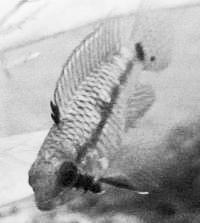
Female A. steindachneri guarding her fry (not shown) in
post-spawning dress. Notice the telltale spot directly above the
lateral line.
|
The adult male is beautiful, with a blue sheen on the body, and a
lyrate caudal fin. No lateral line is seen most of the time, but when
frightened a solid line can be seen with a spot directly above. This
spot is a characteristic of the steindachneri group. The female is the
typical banana yellow
when spawning, also with the black spot
above where the lateral line would be seen. In non-spawning color she
turns a dull yellow-gray and her lateral line can be seen. The spot
remains. Her tail is rounded and she has black ventral fins.
The female had approximately 50 fry, raised on TetraMin fry flake food and baby brine shrimp. When the fry were a month old, she spawned again, though the new batch disappeared, probably due to predation from the first spawn.
The tank is heavily planted with Java fern, Java moss, Anubias, water sprite, and frogbit. They have spawned in both a 10 gallon and 20 gallon tank. In the 10 gallon tank the male became more aggressive, forcing the move.
A. steindachneri are one of the easier Apistos to spawn, as their pH requirements are not strict, and they tend to be fairly hardy. They are a beautiful fish to boot! Definitely a good starter fish.